
INDUSTRIAL
WATER SOFTENERS.
Reliable water softening systems designed for commercial and industrial applications where performance, capacity and continuous softened water are essential.
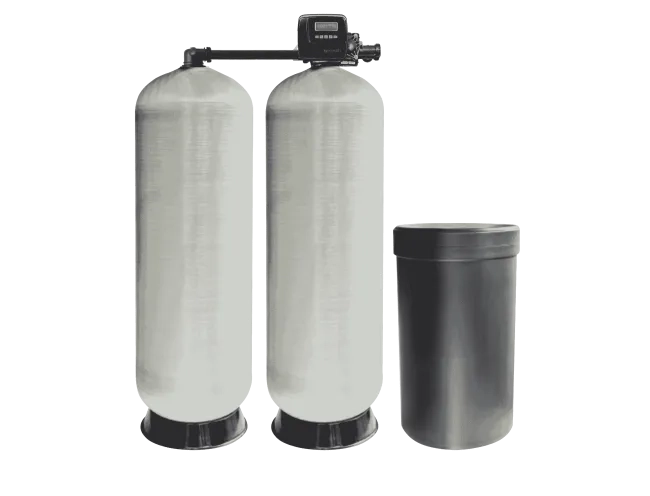
INDUSTRIAL WATER SOFTENING SYSTEMS BUILT AROUND YOUR REQUIREMENTS.
Hard water can create serious problems in commercial and industrial environments.
Calcium and magnesium in hard water can lead to limescale forming throughout pipework, boilers, heat exchangers and other water-using equipment. Over time, scale can restrict flow, reduce efficiency and increase maintenance requirements.
J&F Water Treatment supplies industrial and commercial water softeners designed to reduce water hardness before it reaches critical equipment or processes.
Each system can be specified around your incoming water hardness, required flow rate, daily water consumption, peak demand and whether an uninterrupted supply of softened water is required.
TALK TO OUR WATER TREATMENT TEAM ↗REDUCE
LIMESCALE
Reduce the hardness minerals responsible for scale formation throughout pipework and water-using equipment.
PROTECT
EQUIPMENT
Help protect boilers, heat exchangers, pipework and process equipment from the effects of hard water.
CONTINUOUS
OPERATION
Twin and duplex configurations can provide softened water while another vessel is undergoing regeneration.
BUILT FOR
DEMAND
Systems can be selected around commercial and industrial flow rates, capacity and operating requirements.
CONTINUOUS SOFTENED WATER WHEN YOUR BUSINESS NEEDS IT.
For commercial and industrial applications where a reliable supply of softened water is essential, twin and duplex water softeners provide increased capacity and operational flexibility.
By using two softener vessels, the system can be configured so softened water remains available while one vessel is regenerating.
KEEP YOUR SOFTENED WATER FLOWING.
A single water softener normally needs to stop supplying softened water while the resin is being regenerated.
Twin and duplex systems overcome this limitation by using two resin vessels. Depending on the system configuration, one vessel can remain available while the other regenerates.
This makes them particularly suitable for factories, commercial premises and process applications where interruptions to the softened water supply are undesirable.
TWIN SYSTEM
Typically operates with one vessel supplying softened water while the second vessel is available for regeneration or standby.
DUPLEX SYSTEM
Duplex configurations provide two softening vessels for applications requiring greater capacity, flexibility and continued softened water availability.
We can specify the correct configuration around your flow rate, water hardness, operating hours and peak demand.
DISCUSS YOUR APPLICATION ↗COMMERCIAL & INDUSTRIAL WATER SOFTENERS.
From smaller commercial installations to high-demand industrial applications.
J&F Water Treatment can specify water softening systems around the actual requirements of your site rather than simply selecting a system based on vessel size.
Flow rate, water hardness, daily consumption and peak demand are all considered when selecting the appropriate system.
TWIN WATER SOFTENER
A compact twin-vessel configuration suited to commercial applications requiring dependable softened water and automatic regeneration.
TWIN WATER SOFTENER
Increased softening capacity for commercial and light industrial applications with higher water consumption and flow requirements.
INDUSTRIAL WATER SOFTENER
A larger vessel configuration for industrial installations where increased treatment capacity and reliable operation are required.
CONFIGURATIONS
LARGER INDUSTRIAL SYSTEMS
For higher flow rates, larger daily volumes or specialist process requirements, J&F can specify larger duplex and multi-vessel systems.
DISCUSS YOUR REQUIREMENTS ↗Industrial water softeners should be sized around your water usage and operating conditions — not simply the physical size of the vessel.
TWIN & DUPLEX WATER SOFTENERS.
Commercial and industrial water softeners selected around the demands of your site.
J&F Water Treatment supplies twin and duplex water softening systems for applications ranging from commercial buildings to high-demand industrial processes.
System selection is based on water hardness, required flow rate, daily consumption and peak water demand.
TWIN COMMERCIAL SOFTENER
TWIN WATER SOFTENER
A compact twin-vessel water softener for commercial and light industrial applications requiring a dependable supply of softened water.
TWIN COMMERCIAL SOFTENER
TWIN WATER SOFTENER
Increased vessel capacity for commercial installations with higher water usage and more demanding operating requirements.
INDUSTRIAL WATER SOFTENER
INDUSTRIAL TWIN SOFTENER
A higher-capacity twin water softener for industrial sites where water demand and operating hours require increased treatment capacity.
HIGH CAPACITY SOFTENER
DUPLEX INDUSTRIAL SOFTENER
A larger industrial configuration for sites requiring greater softening capacity, higher water demand and operational flexibility.
LARGE INDUSTRIAL CONFIGURATION
BUILT FOR HIGHER DEMAND.
For factories, process applications and larger industrial sites, J&F can specify higher-capacity duplex and multi-vessel water softening systems around the actual water demand of the installation.
The correct configuration will depend on factors including incoming water hardness, required service flow, peak demand, daily water consumption and the operating pattern of the site.
Choosing a water softener isn't simply a case of selecting the largest vessel. J&F can assess your water hardness, flow rate, daily consumption and peak demand to specify an appropriate system.
ECOSOFT TWIN WATER SOFTENER
HIGH CAPACITY TWIN WATER SOFTENER
The largest complete TWIN softener in this Ecosoft range, designed for higher-demand commercial and industrial applications requiring increased flow and softening capacity.
LARGE INDUSTRIAL WATER SOFTENING
LARGER INDUSTRIAL WATER SOFTENERS.
Some industrial applications require considerably greater flow rates and treatment capacity than a standard commercial twin water softener can provide.
J&F Water Treatment can specify larger duplex and multi-vessel systems around the actual demand of the site, providing a scalable approach for factories, manufacturing facilities and process applications.
HOW DOES AN INDUSTRIAL WATER SOFTENER WORK?
Industrial water softeners use ion exchange to reduce the minerals responsible for water hardness.
Hard water passes through a vessel containing ion-exchange resin. Calcium and magnesium ions are exchanged for sodium ions, producing softened water for use elsewhere within the site.
HARD WATER ENTERS THE SYSTEM
Incoming mains, borehole or process water containing dissolved hardness minerals enters the softener vessel.
WATER PASSES THROUGH THE RESIN
As the water flows through the ion-exchange resin, calcium and magnesium ions are exchanged for sodium ions.
SOFTENED WATER LEAVES THE VESSEL
The treated water leaves the softener with substantially reduced hardness and can then supply the required equipment or process.
THE RESIN IS REGENERATED
Once the resin reaches its operating capacity, a brine solution is used during regeneration to restore its ability to soften water.
FROM HARD WATER TO SOFTENED WATER.
Water hardness is primarily caused by dissolved calcium and magnesium. In an industrial water softener, the incoming water passes through a bed of ion-exchange resin.
The resin exchanges hardness-forming calcium and magnesium ions for sodium ions. As the resin gradually becomes exhausted, the system initiates a regeneration cycle using brine to restore the resin for continued operation.
In twin and duplex installations, a second vessel can allow softened water to remain available while regeneration takes place, depending on the system configuration and control arrangement.
The right industrial water softener depends on the characteristics of the incoming water as well as your flow rate, consumption and operational requirements.
DISCUSS YOUR WATER TREATMENT ↗CHOOSING THE RIGHT INDUSTRIAL WATER SOFTENER.
Correct sizing is critical to the performance of an industrial water softening system.
A system that is too small may regenerate too frequently or struggle to meet peak demand. Oversizing can also result in unnecessary capital and operating costs.
J&F assesses the application before recommending the appropriate system and configuration.
SIX FACTORS WE CONSIDER.
Industrial water softener selection involves more than simply choosing a vessel size. These are some of the key factors used when assessing an installation.
INCOMING WATER HARDNESS
The concentration of calcium and magnesium determines the hardness load placed on the softener resin.
REQUIRED FLOW RATE
The system must be capable of delivering the required service flow without restricting the water supply to downstream equipment.
DAILY WATER CONSUMPTION
Total water usage helps determine the treatment capacity required between regeneration cycles.
PEAK WATER DEMAND
Short periods of high demand can be just as important as average daily consumption when selecting the correct system.
OPERATING HOURS
Whether the site operates for eight hours, extended shifts or continuously influences the required capacity and configuration.
CONTINUOUS SUPPLY
Where softened water cannot be interrupted, a twin or duplex arrangement may allow one vessel to remain available while another regenerates.
HOW WE SPECIFY YOUR SOFTENER
By understanding the water supply and how your site actually uses water, J&F can recommend a system based on operational requirements rather than relying on a generic product selection.
UNDERSTAND THE APPLICATION
We establish where the softened water is required and which equipment or processes it will supply.
ASSESS THE WATER
Incoming hardness and relevant water characteristics are considered alongside the source of the supply.
CALCULATE DEMAND
Flow rate, daily volume, peak demand and operating pattern are used to establish the required capacity.
SPECIFY THE SYSTEM
The appropriate vessel size, control arrangement and twin or duplex configuration can then be selected.
If you know your water hardness, required flow rate and approximate daily consumption, send the details to J&F and we can discuss the most appropriate industrial water softener.
GET SYSTEM ADVICE ↗REAL INDUSTRIAL WATER TREATMENT.
Industrial water treatment isn't just something we specify. It's something we install.
J&F Water Treatment has experience delivering larger duplex water softening systems for demanding industrial environments.
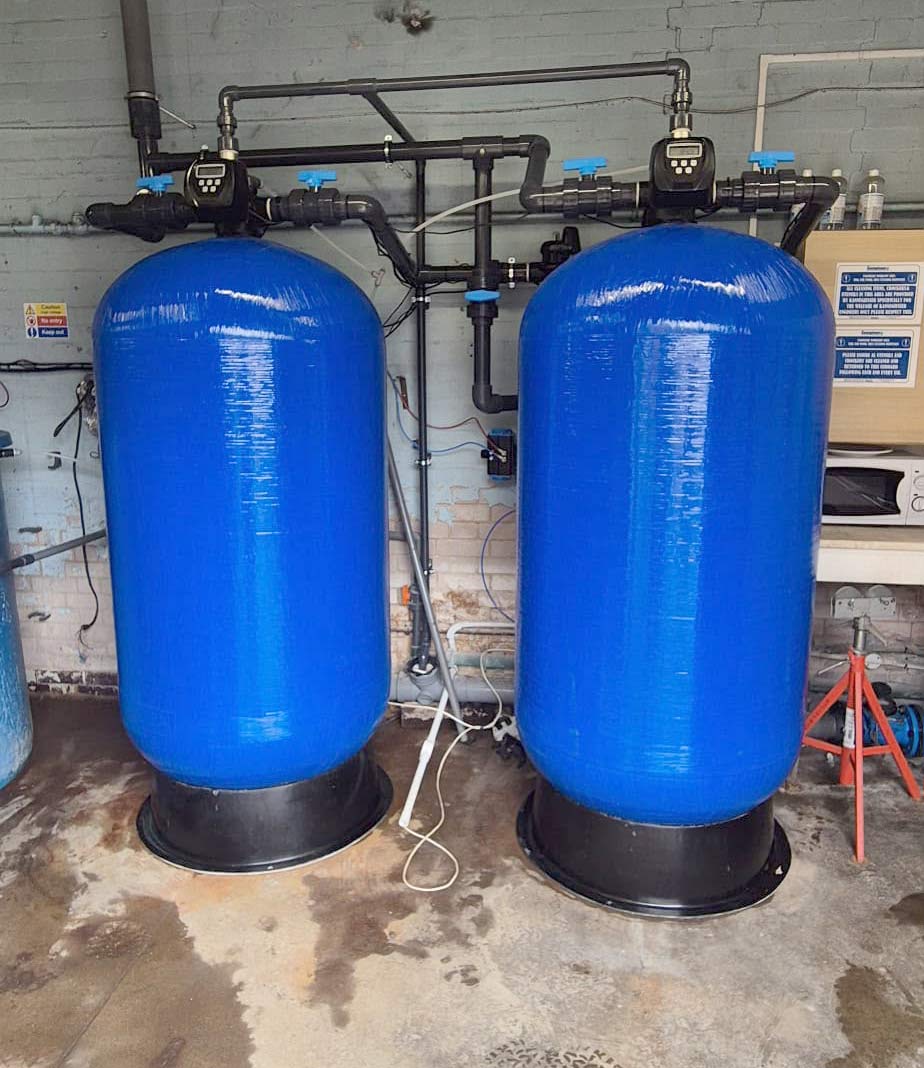
36″ × 72″ DUPLEX SOFTENER.
J&F supplied and installed a large commercial duplex water softener for a UK factory requiring a dependable softened water supply.
The system uses two 36″ × 72″ softener vessels with Clack WS2 control valves, providing a heavy-duty solution for the site's industrial water requirements.
INDUSTRIAL-SCALE WATER DEMAND
The factory required a water softening system capable of supporting a large industrial application where a reliable supply of softened water was essential.
LARGE DUPLEX CONFIGURATION
A duplex arrangement using two large 36″ × 72″ vessels was selected, controlled by Clack WS2 valves to manage the water softening and regeneration process.
CONTINUOUS SOFTENED WATER
The alternating duplex configuration allows one vessel to provide softened water while the other regenerates, helping maintain the softened water supply required by the site.
J&F can assess your water quality, flow, consumption and operational requirements before specifying an industrial water softening system appropriate for the application.
DISCUSS YOUR PROJECT ↗MORE THAN A WATER SOFTENER.
The equipment is only one part of an effective industrial water treatment system.
Correct specification, installation, commissioning and ongoing support all contribute to how effectively the system performs over its working life.
CORRECT SYSTEM SPECIFICATION
We consider water hardness, required flow, daily consumption, peak demand and operating requirements before recommending a system.
INDUSTRIAL EXPERIENCE
From commercial applications to large factory installations, J&F works with water treatment systems designed around real operating demands.
INSTALLATION & COMMISSIONING
A correctly specified system still needs to be installed and commissioned properly. J&F can support the project through to operation.
ONGOING SERVICE & SUPPORT
Water treatment equipment requires ongoing attention. J&F can support industrial systems beyond the initial installation.
SPECIFIED FOR THE WATER. ENGINEERED FOR THE SITE. SUPPORTED BY J&F.
Whether you need a commercial twin softener, a high-capacity duplex system or a larger industrial water treatment solution, talk to J&F about the requirements of your site.
TALK TO J&F ↗INDUSTRIAL WATER SOFTENER FAQs.
Common questions about industrial and commercial water softening systems.
From system sizing and duplex operation to regeneration and maintenance, here are some of the questions we're regularly asked.
01
What is an industrial water softener?
An industrial water softener is a water treatment system designed to reduce the calcium and magnesium responsible for water hardness. It typically uses ion-exchange resin to produce softened water for commercial or industrial equipment and processes.
Industrial systems are generally selected around factors such as water hardness, required flow rate, daily consumption, peak demand and operating pattern.
02
What is the difference between a commercial
and industrial water softener?
Both commercial and industrial water softeners operate using the same basic ion-exchange principle. The difference usually relates to the scale of the application, required flow rate, treatment capacity, control arrangement and operating requirements.
Larger industrial applications may require higher-capacity vessels, larger valves or multi-vessel configurations to satisfy the site's water demand.
03
What is a duplex water softener?
A duplex water softener uses two softener vessels within the treatment system. Depending on the design and control arrangement, the vessels can operate in an alternating or coordinated sequence.
Duplex systems are particularly useful where the site requires a dependable supply of softened water and regeneration needs to be managed without unnecessarily interrupting the process.
04
How do you size an industrial water softener?
Industrial water softener sizing should consider the hardness of the incoming water, required service flow rate, total daily consumption, peak demand, operating hours and the capacity required between regeneration cycles.
Whether the site can tolerate an interruption in softened water supply can also influence whether a single, twin or duplex arrangement is appropriate.
05
How often does an industrial water softener
regenerate?
There isn't one regeneration frequency that applies to every industrial water softener. It depends on factors including water hardness, resin capacity, water consumption and how the control system has been configured.
Correct system sizing helps provide a sensible balance between treatment capacity, water demand and regeneration frequency.
06
Why is softened water used in industrial
applications?
Hardness minerals can contribute to scale formation on pipework and equipment, particularly where water is heated or concentrated.
Reducing hardness can help protect equipment such as boilers, heat exchangers and other water-using plant, while also supporting processes that require controlled water quality.
07
Do industrial water softeners require
maintenance?
Yes. Industrial water softeners should be inspected and maintained as part of the site's water treatment programme.
Requirements vary by system, but can include checking salt levels, control valves, regeneration performance, water hardness and the general condition and operation of the equipment.
08
Can J&F replace or upgrade an existing
industrial water softener?
If an existing system is no longer meeting the site's requirements, J&F can assess the application and discuss an appropriate replacement or upgraded water treatment solution.
This is also an opportunity to review whether the site's water consumption, operating pattern or treatment requirements have changed since the original system was installed.
Tell J&F about your application, existing equipment or water treatment requirement and we'll help you identify the appropriate next step.
CONTACT J&F ↗LET'S TALK ABOUT YOUR WATER.
Whether you're replacing an existing softener, planning a new installation or need help specifying the right system, J&F Water Treatment can help.

Commercial Duplex Water Softener Installation at a Large UK Factory
Reliable Industrial Water Softening for a High-Demand Manufacturing Facility At J&F Water Treatment, we’re proud to support customers who continue

Tailored Water Treatment Solution for Factory Process Water
Client: A UK-based manufacturing facility requiring high-quality process water for critical production stages. Water Source: Mains (town) water supply Application:

Water Hardness in a New Hotel
Initial Analysis A short case study this time on a simple water treatment solution. Not all jobs are complex and